













Telephone: 13913276287
Email:sales@kssyc.cn
Landline: 0512-57506689
fax:(landline) 0512-57506689
Address:No. 1128 Changjiang South Road, Kunshan City, Jiangsu Province (Production: Taicang Changfu Industrial Park)
 Industry Trends
  Current location:
Welding fume dust collector system workflow
During the process of the welding fume dust collector transfer system, each welding diaphragm is divided into a 2-meter small space according to the layout of the welding workshop. A conical exhaust hood is set at the top. The machine room and columns are fixed in the east-west direction, and bracket doors are set in the north-south direction. According to the opening of the welding position, the flexible manipulator is connected to the Φ160mm exhaust hood. The flexible manipulator is used for dust removal. The welding fume dust collector system is connected through a pipeline to a medium-pressure, variable frequency centrifugal fan with an air volume of 10,000m3/h (left and right).
Set a cross-section insert plate 600mm in front of the fan air inlet to adjust the air volume. The motor of the welding fume dust collector system automatically switches according to the adjusted air volume. The fan outlet pipe is a φ600mm square tube or cylinder. The dust generated during welding is collected into the pipe through the flexible arm, and then enters the bag dust collector after being processed by the centrifugal fan. After treatment, the dust reaches the standard and is discharged outdoors. This solution has low one-time investment and simple daily maintenance. The use of variable frequency motors solves the shortcoming of high energy consumption.
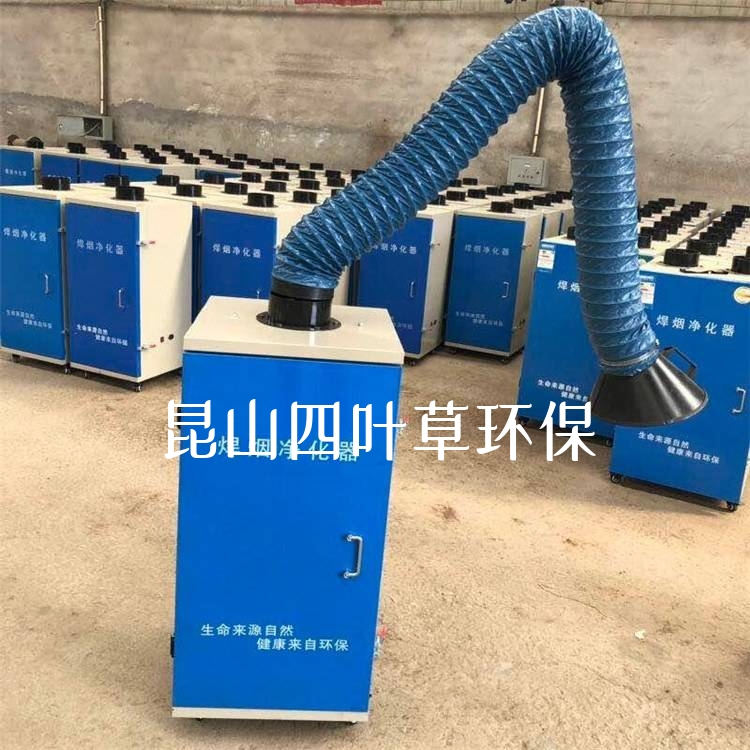
Multi-station welding fume dust collector system structure: composed of 4 parts: shell, filter bag assembly, dust spray device, and dust exhaust device
1. Box: composed of upper box, middle box, ash hopper, and air inlet and outlet;
2. Welding fume dust collector system filter bag assembly: composed of filter bag, filter bag frame, etc.;
3. The dust spraying device consists of air bags, blow pipes, pulse valves, electromagnetic control valves, electronic control instruments, etc.;
4. The ash discharge device of the welding fume dust collector system consists of a flap valve.
Welding fume dust collector system workflow
After the dusty gas enters the ash hopper, due to the sudden expansion of the air flow section and the action of the air flow distribution plate, some coarse particles in the air flow settle on the ash hopper under the action of dynamic and inertial forces. After the dust particles with fine particles and low density enter the dust removal filter chamber of the welding fume dust collector system, the dust is deposited on the surface of the filter cylinder through the combined action of diffusion and screening. The purified gas enters the clean air chamber through the exhaust pipe of the welding fume dust collector system and is discharged by the fan.
The resistance of the filter screen of the welding fume dust collector system increases with the increase in the thickness of the dust layer on the filter surface. When the resistance reaches a certain value, cleaning and maintenance are required. At this time, the PLC program-controlled pulse valve opens and closes, and the lift valve of the first chamber closes to cut off the filter flow, and then opens the pulse. The compressed air rapidly expands into the filter cartridge in a short period of time, causing the dust removal tube to expand, deform, and vibrate. Under the action of countercurrent flushing, the dust adhered to the surface of the filter cartridge will be stripped off and dropped into the hopper. After cleaning is completed, close the electromagnetic pulse valve and open the lift valve, and the chamber returns to the filtering state. Follow Clover to learn more about welding fume dust collectors.